Too many auditors and not enough: audit's capacity paradox
The Big 4 are cutting audit roles while 3 in 4 firms turn away work for lack of people. Will Kuo, RobotX's CFO and a former Director at Deloitte, on why both can be true at once.

Too many auditors and not enough: audit's capacity paradox
The Big 4 are cutting audit roles while 3 in 4 firms turn away work for lack of people. Will Kuo, RobotX's CFO and a former Director at Deloitte, on why both can be true at once.
Too many auditors and not enough: audit's capacity paradox
The Big 4 are cutting audit roles while 3 in 4 firms turn away work for lack of people. Will Kuo, RobotX's CFO and a former Director at Deloitte, on why both can be true at once.

October 6, 2026
A computer science graduate I know was told, by pretty much everyone, that there would be no jobs left by the time he finished his degree. AI was going to write the code. Today he has never been busier. Neither have most of the people he graduated with.
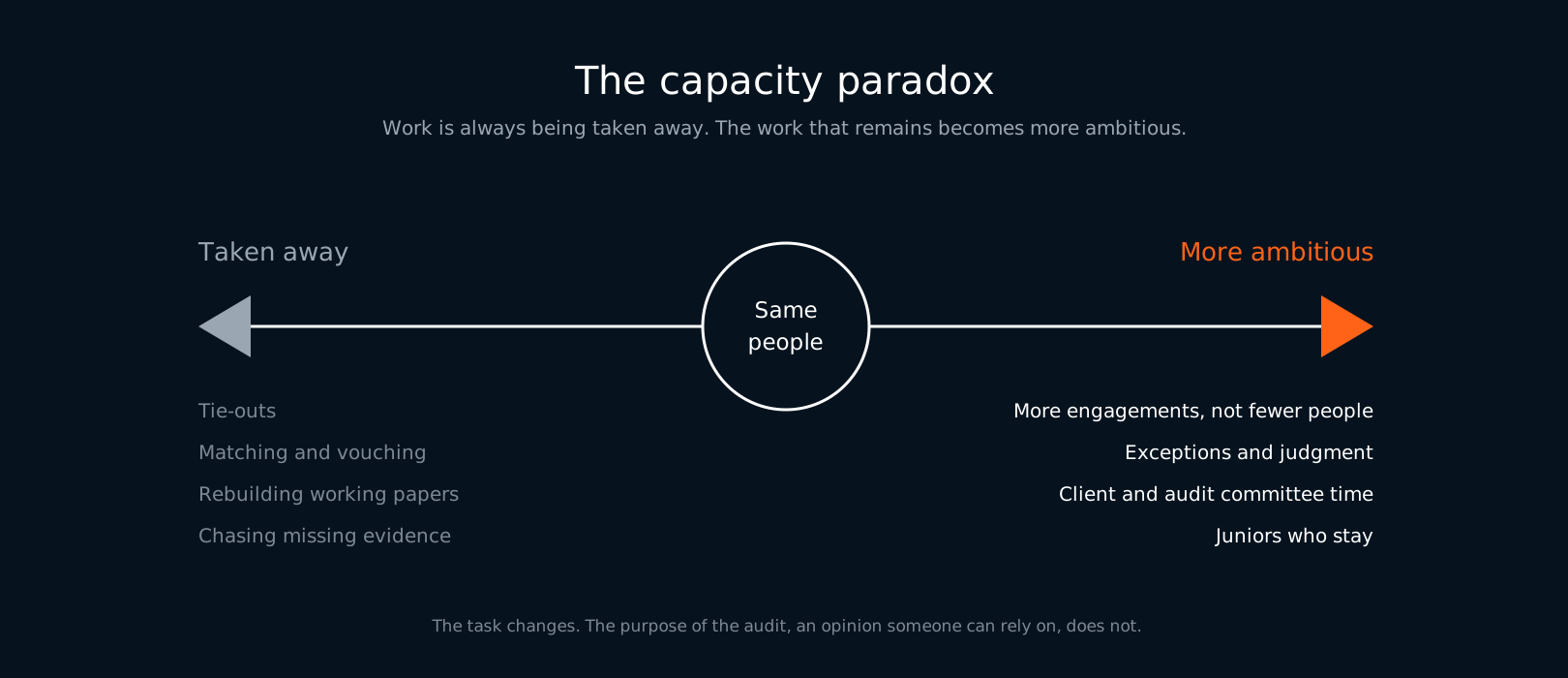
Jensen Huang put the pattern into one sentence: "The purpose of your job, and the tasks and tools that you use to do your job, are related, not the same." Tasks get taken away all the time. The work that remains gets more ambitious. Huang has watched this for more than 3 decades at Nvidia, and he expects AI agents to make people busier than ever.
I think audit is next, and I think that is good news. The purpose of an audit is an opinion someone can rely on. The tasks are tie-outs, matching, vouching and the 8-to-10-week grind of assembling evidence. The tasks are what is being automated. The purpose stays exactly where it is.
[Figure 1: The capacity paradox]
Two things that shouldn't both be true
Look at 2026 and you can watch the profession working this out in 2 directions at once.
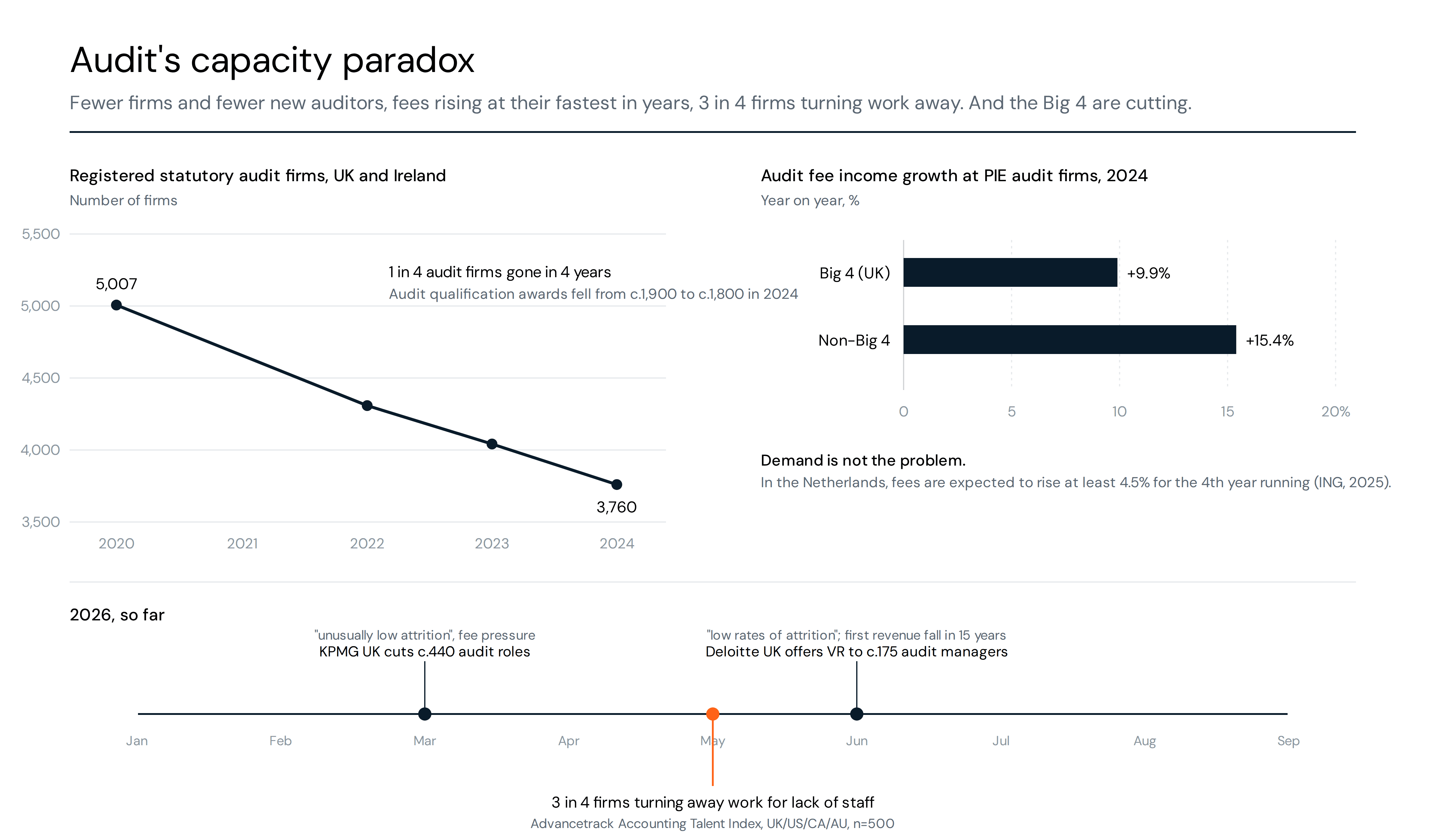
In March, KPMG UK cut around 440 audit roles, roughly 6% of its audit workforce, most of them assistant managers. In June, Deloitte UK offered voluntary redundancy to about 175 managers and assistant managers. Both firms cited unusually low attrition.
In the same season, Advancetrack's 2026 Accounting Talent Index surveyed 500 firm leaders across the UK, US, Canada and Australia. 3 in 4 said they are turning away new work because they don't have the people to deliver it. About the same share are at or near full capacity.
The Netherlands looks the same. CBS data cited by ING shows nearly 2 in 3 accounting, legal and notary firms short of staff, and ING expects fees to rise by at least 4.5% for the 4th year running. Exact's 2024 survey found 59% of Dutch accounting firms short-staffed, and 40% said the quality of their work had dropped as a result.
[Figure 2: Market data of the capacity paradox; Data source: Advancedtrack Accounting Talent Index 2026]
Too many people and too few, in the same profession, in the same year. If capacity is a headcount question, that is a contradiction. If capacity is a question of what each auditor-hour produces, it makes complete sense. The largest firms need each head to carry more. The mid-tier cannot add heads at all. Different symptoms of the same limit.
The pipeline won't close the gap in time
The FRC's 2025 Key Facts and Trends shows UK and Irish student numbers down 0.3%, audit qualification awards down from about 1,900 to 1,800, and the number of registered audit firms down by a quarter since 2020. In the Netherlands, more people are leaving the profession than entering it, more than 1 in 4 NBA members are between 51 and 60, and student intake is expected to flatten from 2026.
These are decade-long trends. No hiring push turns them around before your next busy season, and I don't think any firm is really planning as if it could.
So where is the capacity going?
If the answer isn't more people, it has to be in how the hours already on the team get spent. In my experience, most of them go to the part of the job that needs the least training. That is where I'll pick this up in the next piece.
October 6, 2026
A computer science graduate I know was told, by pretty much everyone, that there would be no jobs left by the time he finished his degree. AI was going to write the code. Today he has never been busier. Neither have most of the people he graduated with.
Jensen Huang put the pattern into one sentence: "The purpose of your job, and the tasks and tools that you use to do your job, are related, not the same." Tasks get taken away all the time. The work that remains gets more ambitious. Huang has watched this for more than 3 decades at Nvidia, and he expects AI agents to make people busier than ever.
I think audit is next, and I think that is good news. The purpose of an audit is an opinion someone can rely on. The tasks are tie-outs, matching, vouching and the 8-to-10-week grind of assembling evidence. The tasks are what is being automated. The purpose stays exactly where it is.
[Figure 1: The capacity paradox]
Two things that shouldn't both be true
Look at 2026 and you can watch the profession working this out in 2 directions at once.
In March, KPMG UK cut around 440 audit roles, roughly 6% of its audit workforce, most of them assistant managers. In June, Deloitte UK offered voluntary redundancy to about 175 managers and assistant managers. Both firms cited unusually low attrition.
In the same season, Advancetrack's 2026 Accounting Talent Index surveyed 500 firm leaders across the UK, US, Canada and Australia. 3 in 4 said they are turning away new work because they don't have the people to deliver it. About the same share are at or near full capacity.
The Netherlands looks the same. CBS data cited by ING shows nearly 2 in 3 accounting, legal and notary firms short of staff, and ING expects fees to rise by at least 4.5% for the 4th year running. Exact's 2024 survey found 59% of Dutch accounting firms short-staffed, and 40% said the quality of their work had dropped as a result.
[Figure 2: Market data of the capacity paradox; Data source: Advancedtrack Accounting Talent Index 2026]
Too many people and too few, in the same profession, in the same year. If capacity is a headcount question, that is a contradiction. If capacity is a question of what each auditor-hour produces, it makes complete sense. The largest firms need each head to carry more. The mid-tier cannot add heads at all. Different symptoms of the same limit.
The pipeline won't close the gap in time
The FRC's 2025 Key Facts and Trends shows UK and Irish student numbers down 0.3%, audit qualification awards down from about 1,900 to 1,800, and the number of registered audit firms down by a quarter since 2020. In the Netherlands, more people are leaving the profession than entering it, more than 1 in 4 NBA members are between 51 and 60, and student intake is expected to flatten from 2026.
These are decade-long trends. No hiring push turns them around before your next busy season, and I don't think any firm is really planning as if it could.
So where is the capacity going?
If the answer isn't more people, it has to be in how the hours already on the team get spent. In my experience, most of them go to the part of the job that needs the least training. That is where I'll pick this up in the next piece.
October 6, 2026
A computer science graduate I know was told, by pretty much everyone, that there would be no jobs left by the time he finished his degree. AI was going to write the code. Today he has never been busier. Neither have most of the people he graduated with.
Jensen Huang put the pattern into one sentence: "The purpose of your job, and the tasks and tools that you use to do your job, are related, not the same." Tasks get taken away all the time. The work that remains gets more ambitious. Huang has watched this for more than 3 decades at Nvidia, and he expects AI agents to make people busier than ever.
I think audit is next, and I think that is good news. The purpose of an audit is an opinion someone can rely on. The tasks are tie-outs, matching, vouching and the 8-to-10-week grind of assembling evidence. The tasks are what is being automated. The purpose stays exactly where it is.
[Figure 1: The capacity paradox]
Two things that shouldn't both be true
Look at 2026 and you can watch the profession working this out in 2 directions at once.
In March, KPMG UK cut around 440 audit roles, roughly 6% of its audit workforce, most of them assistant managers. In June, Deloitte UK offered voluntary redundancy to about 175 managers and assistant managers. Both firms cited unusually low attrition.
In the same season, Advancetrack's 2026 Accounting Talent Index surveyed 500 firm leaders across the UK, US, Canada and Australia. 3 in 4 said they are turning away new work because they don't have the people to deliver it. About the same share are at or near full capacity.
The Netherlands looks the same. CBS data cited by ING shows nearly 2 in 3 accounting, legal and notary firms short of staff, and ING expects fees to rise by at least 4.5% for the 4th year running. Exact's 2024 survey found 59% of Dutch accounting firms short-staffed, and 40% said the quality of their work had dropped as a result.
[Figure 2: Market data of the capacity paradox; Data source: Advancedtrack Accounting Talent Index 2026]
Too many people and too few, in the same profession, in the same year. If capacity is a headcount question, that is a contradiction. If capacity is a question of what each auditor-hour produces, it makes complete sense. The largest firms need each head to carry more. The mid-tier cannot add heads at all. Different symptoms of the same limit.
The pipeline won't close the gap in time
The FRC's 2025 Key Facts and Trends shows UK and Irish student numbers down 0.3%, audit qualification awards down from about 1,900 to 1,800, and the number of registered audit firms down by a quarter since 2020. In the Netherlands, more people are leaving the profession than entering it, more than 1 in 4 NBA members are between 51 and 60, and student intake is expected to flatten from 2026.
These are decade-long trends. No hiring push turns them around before your next busy season, and I don't think any firm is really planning as if it could.
So where is the capacity going?
If the answer isn't more people, it has to be in how the hours already on the team get spent. In my experience, most of them go to the part of the job that needs the least training. That is where I'll pick this up in the next piece.


" width="206.72px"/><path d="M 19.865 14.909 L 7.654 14.909 C 6.916 14.909 6.358 15.089 5.982 15.464 C 5.605 15.839 5.424 16.364 5.424 17.069 L 5.424 31.978 L 0 31.978 L 0 17.069 C 0 16.139 0.12 15.314 0.361 14.579 C 0.579 13.89 0.899 13.237 1.311 12.643 C 1.696 12.1 2.158 11.615 2.681 11.203 C 3.178 10.818 3.719 10.496 4.294 10.242 C 4.846 9.999 5.422 9.813 6.012 9.687 C 6.542 9.573 7.082 9.512 7.624 9.507 L 19.882 9.507 L 19.882 14.909 L 19.867 14.909 Z M 48.277 24.4 C 48.277 25.33 48.156 26.156 47.915 26.906 C 47.675 27.656 47.373 28.302 46.981 28.857 C 46.601 29.4 46.144 29.885 45.625 30.297 C 45.113 30.687 44.57 31.017 44.013 31.257 C 43.463 31.507 42.887 31.694 42.295 31.813 C 41.722 31.933 41.165 31.993 40.653 31.993 L 30.851 31.993 C 30.097 31.993 29.284 31.858 28.395 31.603 C 27.493 31.335 26.653 30.892 25.923 30.298 C 25.17 29.698 24.537 28.917 24.025 27.942 C 23.512 26.982 23.256 25.796 23.256 24.4 L 23.256 17.07 C 23.256 15.69 23.513 14.504 24.025 13.543 C 24.537 12.583 25.17 11.803 25.923 11.188 C 26.656 10.599 27.495 10.156 28.395 9.882 C 29.19 9.632 30.018 9.501 30.851 9.492 L 40.653 9.492 C 42.039 9.492 43.229 9.747 44.209 10.242 C 45.189 10.737 45.972 11.368 46.559 12.118 C 47.149 12.847 47.594 13.682 47.87 14.578 C 48.141 15.464 48.277 16.29 48.277 17.055 Z M 42.845 17.122 C 42.845 16.372 42.665 15.817 42.287 15.457 C 41.911 15.097 41.368 14.917 40.66 14.917 L 30.903 14.917 C 30.18 14.917 29.623 15.097 29.261 15.472 C 28.884 15.847 28.703 16.372 28.703 17.077 L 28.703 24.407 C 28.703 25.113 28.884 25.653 29.261 26.028 C 29.638 26.403 30.181 26.584 30.903 26.584 L 40.66 26.584 C 41.398 26.584 41.94 26.404 42.302 26.028 C 42.664 25.653 42.845 25.113 42.845 24.408 Z M 77.78 24.4 C 77.78 24.91 77.72 25.45 77.599 26.02 C 77.344 27.22 76.824 28.348 76.077 29.322 C 75.666 29.847 75.179 30.308 74.631 30.688 C 74.073 31.078 73.41 31.393 72.687 31.633 C 71.949 31.873 71.12 31.993 70.186 31.993 L 60.384 31.993 C 59.871 31.993 59.329 31.933 58.756 31.813 C 58.17 31.69 57.6 31.504 57.054 31.258 C 56.482 30.999 55.941 30.677 55.441 30.298 C 54.914 29.889 54.452 29.404 54.07 28.857 C 53.678 28.302 53.362 27.642 53.121 26.907 C 52.88 26.171 52.759 25.331 52.759 24.4 L 52.759 0 L 58.184 0 L 58.184 24.4 C 58.184 25.06 58.395 25.6 58.817 25.99 C 59.239 26.381 59.751 26.576 60.384 26.576 L 70.186 26.576 C 70.864 26.576 71.406 26.381 71.783 25.976 C 72.16 25.571 72.355 25.046 72.355 24.4 L 72.355 17.07 C 72.355 16.395 72.16 15.854 71.753 15.48 C 71.346 15.104 70.834 14.909 70.186 14.909 L 60.384 14.909 L 60.384 9.507 L 70.186 9.507 C 70.698 9.507 71.24 9.567 71.813 9.687 C 72.386 9.807 72.943 9.987 73.516 10.242 C 74.088 10.497 74.616 10.812 75.128 11.202 C 75.64 11.592 76.092 12.072 76.484 12.643 C 76.89 13.238 77.205 13.891 77.418 14.579 C 77.659 15.314 77.78 16.139 77.78 17.069 Z M 106.99 24.4 C 106.99 25.33 106.869 26.156 106.628 26.906 C 106.387 27.656 106.086 28.302 105.694 28.857 C 105.314 29.4 104.857 29.885 104.338 30.297 C 103.826 30.687 103.283 31.017 102.726 31.257 C 102.176 31.507 101.6 31.694 101.008 31.813 C 100.435 31.933 99.878 31.993 99.365 31.993 L 89.564 31.993 C 88.81 31.993 87.997 31.858 87.108 31.603 C 86.206 31.335 85.366 30.892 84.636 30.298 C 83.883 29.698 83.25 28.917 82.738 27.942 C 82.225 26.982 81.969 25.796 81.969 24.4 L 81.969 17.07 C 81.969 15.69 82.225 14.504 82.738 13.543 C 83.25 12.583 83.883 11.803 84.636 11.188 C 85.369 10.599 86.208 10.156 87.108 9.882 C 87.903 9.632 88.731 9.501 89.564 9.492 L 99.365 9.492 C 100.752 9.492 101.942 9.747 102.922 10.242 C 103.901 10.737 104.685 11.368 105.272 12.118 C 105.862 12.847 106.307 13.682 106.583 14.578 C 106.854 15.464 106.99 16.29 106.99 17.055 Z M 101.565 17.122 C 101.565 16.372 101.385 15.817 101.008 15.457 C 100.631 15.097 100.089 14.917 99.381 14.917 L 89.624 14.917 C 88.901 14.917 88.343 15.097 87.981 15.472 C 87.605 15.847 87.424 16.372 87.424 17.077 L 87.424 24.407 C 87.424 25.113 87.605 25.653 87.981 26.028 C 88.358 26.403 88.901 26.584 89.624 26.584 L 99.381 26.584 C 100.119 26.584 100.661 26.404 101.023 26.028 C 101.385 25.653 101.565 25.113 101.565 24.408 Z M 145.948 20.072 L 154.575 9.5 L 147.967 9.5 L 142.648 16.02 L 142.06 16.74 L 141.473 16.02 L 136.154 9.5 L 129.546 9.5 L 138.173 20.071 L 138.761 20.777 L 129.546 31.994 L 136.199 31.994 L 142.068 24.814 L 147.937 31.994 L 154.59 31.994 L 145.376 20.777 L 145.963 20.071 L 145.948 20.071 Z M 111.209 14.909 L 111.209 24.4 C 111.209 24.895 111.269 25.436 111.39 26.006 C 111.495 26.591 111.691 27.146 111.932 27.716 C 112.188 28.272 112.505 28.812 112.912 29.322 C 113.002 29.457 113.108 29.577 113.228 29.697 C 113.228 29.727 113.258 29.742 113.273 29.757 C 113.454 29.952 113.665 30.133 113.876 30.297 C 113.906 30.312 113.936 30.327 113.951 30.357 C 114.087 30.463 114.192 30.597 114.343 30.687 C 114.936 31.083 115.58 31.396 116.257 31.618 C 116.272 31.618 116.287 31.633 116.302 31.633 C 116.799 31.798 117.357 31.888 117.929 31.933 C 118.231 31.963 118.517 31.993 118.803 31.993 L 126.028 31.993 C 126.028 31.993 126.119 31.948 126.119 31.903 L 126.119 26.652 C 126.119 26.652 126.074 26.562 126.028 26.562 L 118.818 26.562 C 118.668 26.562 118.517 26.547 118.366 26.532 C 117.869 26.472 117.477 26.307 117.191 26.007 C 116.829 25.647 116.649 25.137 116.633 24.461 L 116.633 16.816 C 116.638 15.754 117.5 14.896 118.562 14.895 L 126.044 14.895 C 126.044 14.895 126.134 14.85 126.134 14.805 L 126.134 9.567 C 126.134 9.567 126.089 9.477 126.044 9.477 L 116.724 9.477 C 116.724 9.477 116.633 9.432 116.633 9.387 L 116.633 0.091 C 116.633 0.091 116.588 0.001 116.543 0.001 L 111.284 0.001 C 111.284 0.001 111.194 0.046 111.194 0.091 L 111.194 9.507" fill="rgb(0, 0, 0)" height="31.994000000000007px" id="GApsnr1aS" transform="translate(52.145 0)" width="154.59000524902342px"/><path d="M 7.444 0 C 3.33 0 -0.008 3.339 0 7.435 L 0 31.992 L 29.172 31.992 L 29.172 26.695 L 5.319 26.695 L 5.319 7.435 C 5.319 6.257 6.276 5.312 7.451 5.312 L 36.081 5.312 L 36.081 26.71 L 41.4 32.007 L 41.4 0.001 L 7.444 0.001 Z" fill="rgb(255, 99, 24)" height="32.007px" id="lTW__fqmh" transform="translate(0 0.001)" width="41.4000143498809px"/><path d="M 5.44 0 L 0 0 L 0 6.82 L 5.44 6.82 Z M 16.945 0 L 11.505 0 L 11.505 6.82 L 16.945 6.82 Z" fill="rgb(255, 99, 24)" height="6.820000000000002px" id="BceVedKvU" transform="translate(12.227 12.598)" width="16.94500011444092px"/></g></svg>)